Imagine I offered you a wager.
Put up $200,000. You will probably borrow most of it, on a loan that can almost never be erased, even in bankruptcy. In exchange you get a ticket. If the ticket wins, you earn a solid return, somewhere around 12 percent a year, better than the stock market. If it loses, you are out the money and four years of your life, with nothing to show for it but the debt.
Here is the catch. The 12 percent is the number they print on the wall. They never print your odds of winning. And your odds depend almost entirely on which ticket you are holding.
That is the wager 18-year-olds make every fall. They are shown the winner’s payout and told it is a sure thing. It is not a sure thing, and it is not a single thing. Some tickets in this game are among the best bets you can make anywhere. Others lose almost every time. The trouble is that everyone is handed the same number, the winner’s number, no matter which ticket they hold.
Let me show you how to read your own.
The number on the wall is the winner’s payout
The Federal Reserve published an analysis in 2025 putting the return on a college degree at about 12.5 percent a year, and noted it beats stocks and bonds.[1] That number got quoted everywhere as proof college pays.
Read what it actually measures. The 12.5 percent is the median for the people who finish. It is not even the prize for a clean win. It blends the graduates in good jobs with the ones stuck in work the diploma never required. Then it drops the roughly 39 percent who never finish at all. It keeps the winners and quietly sets the rest aside.
That is the first thing the number hides. It is an average of survivors. But it hides something bigger, and that is the part that should change how you read the whole bet.
The average is a disguise
Here is the move the famous number pulls. It takes a group that runs from near-certain loss to one of the best investments on earth, averages it into a single figure, and hands that figure to everyone.
Take a well-prepared student in a high-demand major, at a school where almost everyone finishes, paying a low net price. Her odds and her payoff blow the average away. For her, college is one of the best investments anywhere. It is not close.
Now take a student in an oversupplied field, paying full sticker price on borrowed money, at a school where barely half finish. His odds and his payoff fall far below the average. For him, the same degree is a likely loss.
Those two are not a few points apart. They are on opposite ends of the board. The average sits between them and describes neither. When the Fed quotes 12.5 percent, the 18-year-old holding a great hand and the one holding a terrible hand hear the same number, and both are told it is safe.
That is the real sleight of hand. Not that college never pays. That the winner’s number gets sold to everyone, including the millions whose true odds are nothing like it.
So count your own odds
Start with the two facts the people who promote college publish themselves.
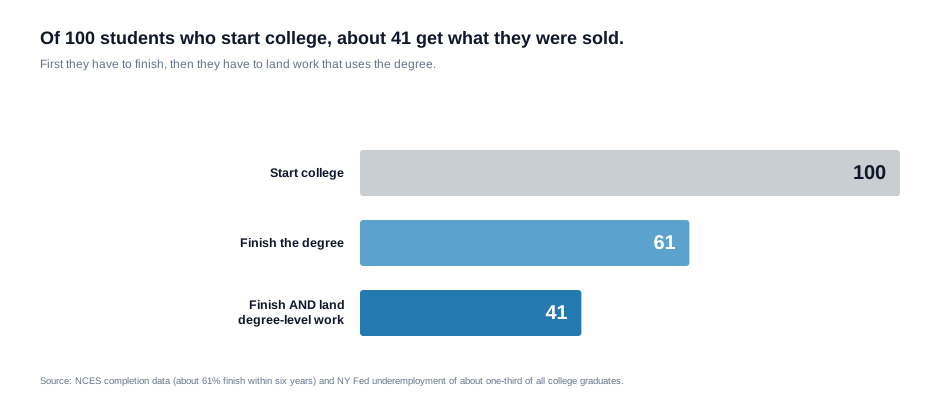
About 39 percent of students who start never finish.[2] They leave with debt, lost time, and no degree, the worst outcome in the deal. So six in ten finish.
Of the ones who finish, about a third are underemployed over their careers, working jobs that never required the degree.[3] So about two-thirds of finishers land the kind of work the degree was supposed to buy.
Put those together for the average student and the chance of both finishing and landing degree-level work is roughly 61 percent times 67 percent, about 41 percent. Two in five.
But 41 percent is the average player’s number, and you are not the average player. Run the same two questions for your actual case. What share of students finish at the school you are looking at? What do graduates of your specific major really earn, and how many of them work in the field? Those numbers exist, and they swing the odds hard in both directions. A strong program at a school where nearly everyone finishes is a different bet entirely from an open-enrollment school where half drop out. The average buries that difference. Your job is to dig it back up.
What the average bet looks like, and why the average is the wrong thing to read
For the average player, the bet really is poor, and it is worth seeing why, because it explains the spread.
Take the 12.5 percent and weight it by the six in ten who finish. You are down to about 7.6 percent. That is the completion-weighting I work through in full in Degrees of Assumption. And it is generous, because it pretends the dropouts simply broke even. They did not. They lost. Weight the losses in, and the average expected return on enrolling lands well under 8 percent. A real chance of a six-figure loss sits underneath it.
That is a weak return on a huge stake. And the stake is borrowed, on a loan you cannot escape in bankruptcy. It is not a good bet. If college were one product at one price, that would be the end of the story, and the story would be bad.
But it is not one product. That under-8-percent figure is an average of the same wild range, the near-certain losses dragging down the genuine winners. No real student faces the average. Every real student faces their own odds. Those odds run from terrible to excellent. A handful of things they can actually look up decide where they land.
How to read your hand
None of this means college is a scam, and the money math is not the whole of the value. A degree carries things a return cannot capture, and early underemployment often fades with time. Hold all of that.
But the money is what families borrow against, and on that ground the rule is simple. Stop reading the number on the wall. Read your own ticket. Look at your specific major and school. Find what its graduates actually earn and how many of them finish. Compare that to the price you will really pay, not the sticker, and to the plain alternative of going straight to work. The famous number was never going to tell you whether to take the bet. It cannot. It is describing a thousand other people at once. Only your own numbers describe you.
You can run yours in a few minutes right here on our site.[4] If you want to see exactly how the famous returns get inflated, I take the major studies apart in a companion piece, Auditing the Numbers That Say College Pays. The loan behind the bet, the most dangerous part of the whole wager, is the subject of Two Kinds of Debt. And I first laid out the idea that a degree is a bet families are never shown the odds of in Warning: This Degree Could Be Hazardous to Your Wealth. This piece hands you the odds.
Sources and references
- Abel, Jaison R., and Richard Deitz. “Is College Still Worth It?” Liberty Street Economics, Federal Reserve Bank of New York, 16 Apr. 2025. Accessed June 15, 2026. The 12.5 percent return for the median graduate.
- National Student Clearinghouse Research Center. “Completing College: National and State Reports.” National Student Clearinghouse Research Center, 2023. Accessed June 15, 2026. About 61 percent of students who start finish a credential within six years counting those who transfer and graduate elsewhere, so roughly 39 percent do not finish. NSC rates that include transfers are higher than traditional NCES same-institution-only figures because they count transfer-out completers.
- Federal Reserve Bank of New York. “The Labor Market for Recent College Graduates.” Federal Reserve Bank of New York, 2026. Accessed June 15, 2026. Underemployment of about 42 percent for recent graduates in 2025 and near one-third, about 34 percent, for all college graduates over a career.
- Institution-level and program-level returns are from the author’s own model. Run any school and major using the guided ROI calculator or our basic ROI calculator.