You have seen the number. A bachelor’s degree is worth about a million dollars more over a lifetime than a high school diploma. It comes from Georgetown’s Center on Education and the Workforce, it lives in admissions brochures and news segments, and it has done more than any single statistic to convince American families that college always pays.[1]
It is also not a return.
I spend a lot of time inside the research on whether college is worth it. On collegeroi.org I take the biggest studies apart one at a time, in separate pieces on Georgetown’s ROI rankings and College Payoff, the Institute for Higher Education Policy, and the New York Fed’s math. Here I want to step back and audit the whole field at once. Sort the studies into two piles and the real picture gets clear. It is neither the cheerful one the schools sell nor the cynical one the skeptics shout.
The first pile: numbers that are not returns
Start with the famous ones, because they are the weakest.
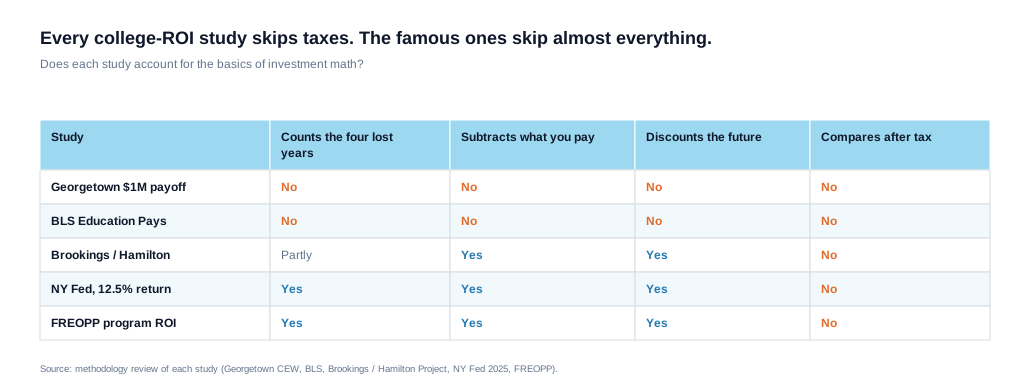
Georgetown’s million-dollar premium is a gross lifetime sum. It adds up what degree-holders earn and what high school graduates earn and reports the gap. It subtracts nothing. It does not subtract the cost of the degree. It does not subtract the four years of paychecks a high school graduate earns while the college student studies and borrows. It does not account for the higher taxes on the higher salary. And it does not discount, so a dollar earned at 60 counts the same as a dollar today, which is not how money or investing works.
Run those four corrections, using the very same earnings data, and the million-dollar premium does not just shrink. At the median, at full price, it can flip to a loss. That is not a rhetorical flourish. It is what the arithmetic does when you treat college like the investment it is, and I show the full recomputation in my standalone piece on Georgetown’s College Payoff. The short version is that the famous number measures the size of the prize and quietly ignores the price of the ticket and the years you spend standing in line for it.
The Bureau of Labor Statistics chart belongs in the same pile, the one that shows earnings climbing and unemployment falling at every step up the education ladder.[2] It is accurate. It is also a snapshot of the people who finished and are working full-time, with no costs, no dropouts, and no account of whether those people would have done well anyway. It describes survivors. It gets used as a promise.
These are the numbers in the marketing, and they are the easiest to take apart, because they were never built to answer the question a family actually asks. They answer what degree-holders earn. They do not answer whether this degree, at this price, is worth it for this student.
The second pile: numbers that actually try
Now the harder, more honest studies, and here I have to be fair, because the skeptic’s lazy move is to pretend everyone ignores costs. They do not.
Preston Cooper, at the Foundation for Research on Equal Opportunity, built the most rigorous version I know of. He works at the level of individual programs, tens of thousands of them. He subtracts the net price. He counts the foregone earnings. He discounts to present value. He even estimates what each student would likely have earned without the degree, and he adjusts for the real chance of not finishing. That is close to doing it right. But after all of it, he still finds a positive median return, roughly $160,000 for the typical bachelor’s program.[3]
The New York Fed’s 2025 analysis does much of the same work and lands on a 12.5 percent return, which it notes beats stocks and bonds.[4]
So is the skeptic simply wrong? No, and this is the part both camps miss. The story in the rigorous data is not a high average. It is enormous spread. The New York Fed concedes, in a companion piece it published the very same week, that for the bottom quarter of graduates college may not pay at all.[4]
The average is real, and the average is a disguise. It blends the petroleum engineer with the graduate stocking shelves and reports the midpoint as if it were your future.
Run the same kind of math across every four-year college in my own model, and the price decides almost everything. At full sticker price, only about one in five bachelor’s institutions clears the bar for the median student, so roughly four in five leave that student worse off than going straight to work. And that bar assumes the student finishes and earns the school’s median. Counting the ones who do not only widens the gap. Drop the cost to the median net price students actually pay after aid, and the odds improve but do not reach safety. Even then fewer than half clear the bar, and about 58 percent of institutions still leave the median student behind. Only when college is free does the median tip to a clear win. That is the point. The price you pay is the whole game, and the average hides it. The rigorous studies, read honestly, do not say college always pays. They say it depends, and the spread is the whole story.
The flaw even the good studies share
There is one error that runs through all of them, the marketing numbers and the rigorous ones alike, and almost nobody names it. Taxes.
Every study above compares earnings before tax. But a college graduate’s higher salary is taxed at a higher rate, so the after-tax gap between the two paths is meaningfully smaller than the pre-tax gap, often by a fifth or more over a career. A higher salary you never take home is not a return to you. It is a return to the Treasury. Any honest analysis of an investment accounts for the tax treatment of its returns. The college studies, even the careful ones, skip it. My own model corrects for it, which is part of why its numbers land lower than the cheerful ones.
The question the whole field tiptoes around
A fair audit cannot stop at costs and taxes, because there is a deeper objection, and it cuts against my own side as much as anyone’s. How much of the premium is the degree, and how much is the person?
The students who finish college were, on average, different before they ever enrolled. More prepared, more advantaged, more likely to earn well on any path. So part of what every one of these studies credits to the degree may simply be the people who got it. The best research here, from economists like Stacy Dale and Alan Krueger, finds that the earnings edge from attending a more selective college largely disappears once you compare students who were good enough to get into the same schools.[5] Selection, not prestige, drove much of the gap. That research measured a narrower question, though. It asked which college you attend, not whether you attend at all. The bigger question is how much of the college-versus-high-school gap is the student and not the schooling. There, most economists put the selection share lower, often around a tenth, and the estimates are still argued over.[6] Either way, some of the premium every study credits to the degree belongs to the person who earned it, and I take up that debate in the book.
I do not raise this to argue college is worthless, and the same research is careful on exactly this. The returns stay real and meaningful for low-income and first-generation students, the ones for whom the credential opens a door that would otherwise stay shut.[6] That is the honest shape of it. The premium is largest precisely where it is least about prestige and most about access. But it means even the rigorous returns are partly measuring the student, not the schooling, and a number that cannot separate the two should be read with humility.
What the audit actually concludes
Put the two piles together and the conclusion is not the one either side wants.
The numbers that say college always pays are mostly not returns at all. They are gross sums and survivor snapshots dressed up as investment analysis, and the most famous of them can flip negative at the median, once you pay full price and do the math properly. The numbers that do the math properly do not vindicate the skeptic either. They find a real but wildly uneven return, positive for some programs and badly negative for others, shrunk further by taxes nobody counts, and clouded by a selection effect nobody can fully remove.
So the only honest answer the entire literature supports is the one no headline will run. It depends. It depends on the major, the school, the price you actually pay, and the student you are. A petroleum engineering degree at a low net price is one of the best investments available to anyone. A degree in an oversupplied field at full sticker can be a six-figure mistake. The average that blends them is worse than useless, because it reassures the person about to make the mistake.
So stop quoting the million dollars, and stop quoting the chart. Run your own number, for your school, your major, and your price, and decide from that. The whole point of an honest audit is that it hands the question back to your own case, which is the only one that was ever going to settle it. I make the gut-level version of this argument in a companion piece, College Is a Bet, which works out the student-level odds, completion risk and all, that sit beneath these per-college numbers.
Reference Sources
- Georgetown University Center on Education and the Workforce. “The College Payoff: Education, Occupations, Lifetime Earnings.” Center on Education and the Workforce, Georgetown University, 2021. Accessed June 15, 2026. The source of the roughly one-million-dollar lifetime premium.
- Bureau of Labor Statistics. “Earnings and Unemployment Rates by Educational Attainment.” U.S. Bureau of Labor Statistics, 2024. Accessed June 15, 2026. Median earnings and unemployment by educational attainment (“Education Pays”).
- Cooper, Preston. “Does College Pay Off? A Comprehensive Return on Investment Analysis.” Foundation for Research on Equal Opportunity, 2024. Accessed June 15, 2026. Roughly $160,000 median return for the typical bachelor’s program.
- Abel, Jaison R., and Richard Deitz. “Is College Still Worth It?” Liberty Street Economics, Federal Reserve Bank of New York, 16 Apr. 2025. Accessed June 15, 2026. The 12.5 percent return and the companion finding that for the bottom quarter of graduates college may not pay.
- Dale, Stacy, and Alan B. Krueger. “Estimating the Payoff to Attending a More Selective College.” National Bureau of Economic Research, Working Paper 7322, 1999 (and 2011 update). Accessed June 15, 2026. The selective-college earnings edge largely disappears once comparable students are compared.
- Oreopoulos, Philip, and Uros Petronijevic. “Making College Worth It: A Review of Research on the Returns to Higher Education.” National Bureau of Economic Research, Working Paper 19053, 2013. Accessed June 15, 2026. On the lower whole-decision selection share and the larger, real returns for low-income and first-generation students. Further reading: the full recomputation of Georgetown’s, IHEP’s, and the New York Fed’s figures appears in separate pieces on collegeroi.org, on Georgetown’s two reports, IHEP, and the New York Fed’s math. The institution-level results come from the author’s own model. You can run the return on any school and major on this site.