Sarah and Marcus are both 28, and they earn the same $48,000 a year. They work just as hard. Over the next 30 years, one of them will own a home and build hundreds of thousands of dollars of wealth. The other will spend her first decade paying off a loan instead of a house, start ten years late, and never catch up.
The difference between them is not effort, talent, or luck. It is which kind of debt the government let them borrow.
Marcus skipped college and went straight to work. He has no degree and no student debt. When he applies for a mortgage, a lender checks his income, sees no other debt payments, and approves him. He buys a modest first home with a small down payment.
Sarah went to college, then earned a master’s. She earns the same $48,000, but she carries $62,000 in federal student loans at 6.5 percent, well above what the average borrower owes, which makes the effect easy to see.
Her payment runs about $704 a month, roughly $84,000 over 10 years. When she applies for a mortgage, that $704 is already sitting on her ledger, eating the room a lender will give her. She qualifies for far less house, and she has little left to save for a down payment while she pays the loan.
So she rents.
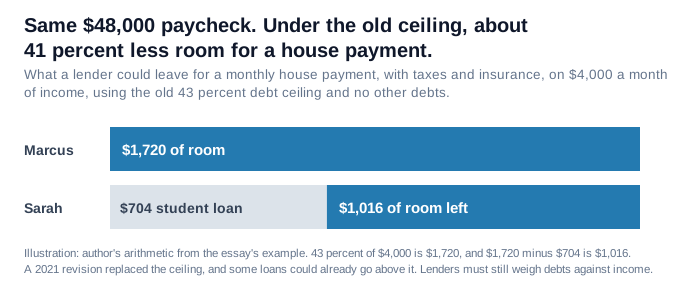
One thing I should be straight about. I gave Sarah degrees that did not raise her pay, so she earns what Marcus earns without them. That is deliberate. It strips the comparison down to the debt itself.
And that outcome is not rare. For many graduates, the degree does not lift income the way the brochure promised.
But many degrees do pay. For the graduates who hold them, a student loan can be some of the best money they ever borrow, and the higher salary buys back some or all of the lost mortgage room.
What does not change is the rule underneath. At the same income, the borrower carrying a student loan payment qualifies for less house than the one who carries none. Hold income equal, the way I have here, and you see the machine with nothing else in the way.
Same income. Same drive. One of them builds wealth through a home he owns and that gains value. The other pays down a debt with no asset behind it. The government’s rules built that gap, and they run exactly backward.
The inversion
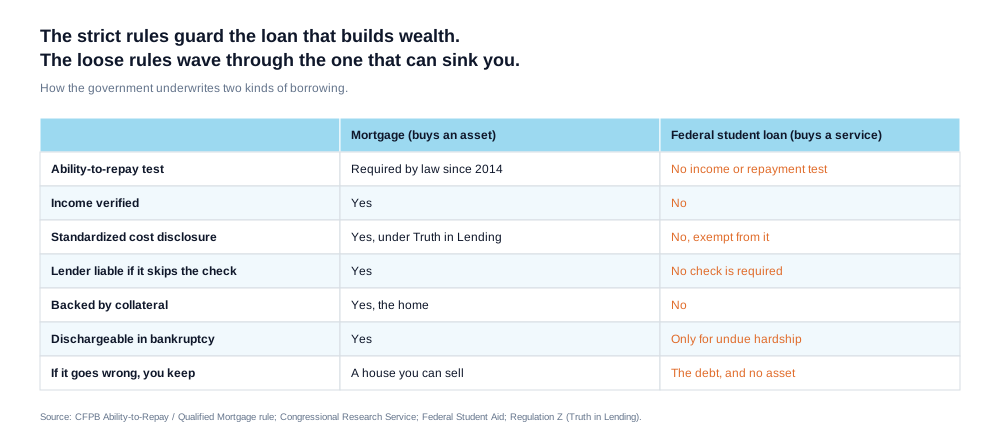
Here is the strange part. The government runs two completely different sets of rules for checking whether a borrower can repay, and it applies the strict one to the debt with an asset behind it and the loose one to the debt with none.
A mortgage buys an asset. A house is collateral. Its value tends to rise. You can borrow against it. For most families, a home is the main form of wealth they hold.[1] And to get that loan, you face a wall of scrutiny.
A student loan buys a service with an uncertain payoff and no collateral at all. If the degree does not pay, you are left holding the debt and nothing else. And to get that loan, you face almost no scrutiny whatsoever.
Strict rules for the asset. Almost none for the gamble. That is the inversion, and it quietly sorts people into owners and renters.
How the government made mortgages hard
After the 2008 housing collapse, Congress decided that lending people money they could not repay was dangerous, and it was right. Since 2014, under the Dodd-Frank reforms, a mortgage lender must make a documented, good-faith determination that you can actually repay the loan before handing you the money. This is the Ability-to-Repay rule.[2][3]
To clear it, a lender verifies your income against tax records and pay stubs, confirms your employment, counts your assets, and adds up your existing debts.
For years, the standard route to the rule’s strongest legal protection required your total monthly debt to stay under 43 percent of your income. Loans backed by federal agencies or eligible for sale to Fannie Mae and Freddie Mac could qualify above it. A 2021 revision replaced that ceiling with a test based on the loan’s price, but the lender must still weigh your debts against your income.[3]
And the lender answers for getting it wrong. A borrower who was never properly checked can hold that against the lender in court, so the lender has every reason to check carefully before it lends.
This is sound policy for an asset purchase. The problem is what happens on the other side of the ledger.
How the government kept student loans effortless
A federal student loan asks almost none of those questions.
The one real check is narrow, a look at whether you have an adverse credit history, meaning a record of past delinquencies, and it applies only to PLUS loans, the ones parents and some graduate students can take out.[4]
Beyond that, there is no income verification, no debt-to-income test, no ability-to-repay determination, and no cap tied to what you are likely to earn. A student admitted to a program can borrow for it, year after year, with no look at the borrower’s prospects.
A 2025 law will start cutting off loans to degree programs whose graduates typically earn less than working adults a rung below them. For an undergraduate program, that means adults with only a high school diploma. For a graduate program, it means adults with only a bachelor’s. But the law judges the program after the fact. It never asks what the degree cost, or whether this borrower can carry this loan.[5]
Nothing in the process asks whether your likely income can carry the loan, or whether it makes any financial sense.
Federal student loans are even carved out of the Truth in Lending Act, the law that makes mortgage and car lenders hand you a standardized disclosure of the true cost of credit.[6] Borrow $50,000 in student loans and you do not get that clean, comparable cost sheet.
The reason the discipline is missing is not that the government cannot check. It insures or guarantees many mortgages through the FHA, the VA and the USDA, and those loans still have to meet the ability-to-repay rule.[3]
With a federal student loan, the lender is the government and the taxpayer absorbs the default, yet no law asks anyone to check whether you can repay. The rule was never written, so no one runs the check.
We learned half the lesson from 2008. We tightened the loan that buys an asset and left wide open the loan that buys a bet, with no one required to check the borrower.
And the exits run backward too
The asymmetry does not even stop at the front door. If Marcus truly cannot pay his mortgage, he has a way out. In the worst case he gives up the house, and bankruptcy court can wipe away any balance the sale does not cover.
If Sarah cannot pay her student loan, she is stuck with it in nearly every case, because Congress wrote student debt out of that same bankruptcy relief. Lawmakers did it in stages, starting in 1976, tightening it in 1990 and 1998, and extending it to private loans in 2005.[7]
Today bankruptcy can clear it only if she proves an undue hardship in a separate lawsuit inside her bankruptcy case, and few borrowers even try.[7]
The debt that bought a house has an exit. The debt that bought a degree has only a narrow one. Backward again.
The trap this builds
Now watch how the inversion compounds into a wealth gap that lasts a lifetime.
Marcus’s debt turned into an owned asset. As he pays down the mortgage and the house grows in value, he builds equity. He can borrow against that equity to cover an emergency, start a business, or buy a second property. His debt is a ladder.
Sarah’s debt turned into a monthly bill with nothing underneath it. If her degree pays off, she slowly climbs out. If it does not, and for a large share of graduates it does not, she is left paying a loan that bought her nothing she can borrow against. Her debt is an anchor.
And here is the cruelty of the design. The loan that was easy to get is the same loan that shrinks the mortgage you can get later. So the asset-building mortgage is hardest to reach for exactly the people the system steered into the student loan.
The strict rule and the loose rule feed each other. The loose loan loads you with debt, and the strict loan then uses that debt to keep you out of the asset for years.
The effect is real. Four Federal Reserve economists, Alvaro Mezza, Daniel Ringo, Shane Sherlund and Kamila Sommer, found that every $1,000 of student debt lowers the homeownership rate of public four-year college students in their mid-twenties by about 1.5 percentage points. They put that at an average delay of 2.5 months in buying a first home.[1]
In a 2019 Fed article, three of them called rising student debt “an important factor” in the drop in young adults’ homeownership, but “not the central cause of the decline.”[1]
The labor market adds to it. The New York Fed has tracked recent-graduate underemployment, the share working in jobs that do not typically require a degree, above 40 percent in recent years.[8]
And an analysis by The HEA Group found that at about one in four institutions of higher education, certificate schools included, most former students earn less a decade after they enroll than the typical high school graduate does. That analysis pegs the high school median at around $32,000.[9] For those who borrowed, the loan did exactly what the mortgage rules were built to prevent. It created debt without building the income to escape it.
Same person, two systems
Run Sarah and Marcus out 30 years.
Marcus’s housing payments slowly turn into a paid-off home plausibly worth two to three times what he paid for it, plus the borrowing power he held against it along the way.
Sarah spends her first ten years paying about $84,000 to clear a loan that bought no asset at all, and her rent checks in those years turn into nothing she owns. When she finally buys, she starts ten years behind him, and at the same income she never closes the gap.
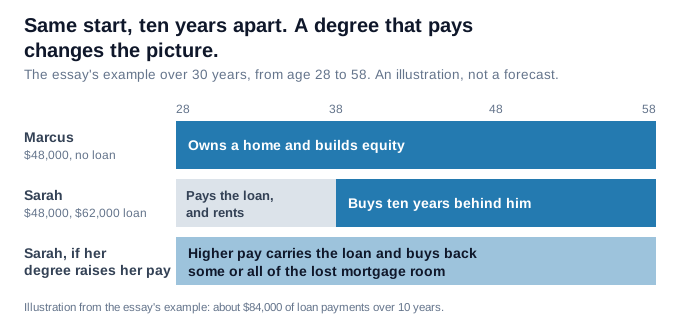
Same starting income. Same effort. One ends with a paid-off house and a cushion. The other ends a decade behind.
Nothing about their character produced that gap. The government’s rules produced it, by deciding that the loan that builds wealth deserves a wall of caution and the loan that can sink you deserves a rubber stamp.
The fix is not complicated
The inversion is fixable, because it is a choice, not a law of nature. We do not have to make student loans as hard to get as mortgages. We have to stop pretending they deserve no scrutiny at all.
A loan for a program whose graduates cannot earn enough to repay it is exactly the kind of loan the mortgage rules were written to stop. A repayment check would not be there to stop the student headed for a degree that pays, any more than a mortgage check is there to stop the buyer who can afford the house.
Congress took a first step in 2025 by judging programs on what their graduates earn. What is still missing is the check mortgage lenders already run. Apply a fraction of that same logic, an honest look at whether the borrower is likely to be able to repay, and you would steer far fewer Sarahs into debt that buys them nothing they can build on.
The price that makes these loans so large has its own bad design, the subsidies I describe in my book. The missing check is the second half of that story.
We decided, after one crisis, that it was reckless to lend people money they could not pay back for a house. It is just as reckless to lend them money they cannot pay back for a degree. Until the rules for the two kinds of debt stop running backward, the system will keep turning equally capable people into owners and renters, and letting the result pass for merit.
Reference Sources
- Mezza, Alvaro, Daniel Ringo, Shane Sherlund, and Kamila Sommer. “Student Loans and Homeownership.” Finance and Economics Discussion Series 2016-010r1, Board of Governors of the Federal Reserve System, June 2017 (later published in the Journal of Labor Economics, 2020). Accessed September 28, 2026. On the effect of about 1.5 percentage points per $1,000 of debt, “equivalent to an average delay of 2.5 months in attaining homeownership,” and on home equity as “the major form of wealth holding for most households.” Also Mezza, Alvaro, Daniel Ringo, and Kamila Sommer. “Can Student Loan Debt Explain Low Homeownership Rates for Young Adults?” Consumer & Community Context, Board of Governors of the Federal Reserve System, January 2019. Accessed September 28, 2026. On rising student debt as “an important factor in explaining their lowered homeownership rates, but not the central cause of the decline.”
- Consumer Financial Protection Bureau. “Ability to Repay and Qualified Mortgage Standards Under the Truth in Lending Act (Regulation Z).” Consumer Financial Protection Bureau, in effect since 2014. Accessed September 28, 2026.
- Congressional Research Service. “The Qualified Mortgage (QM) Rule and Recent Revisions.” Congress.gov, Library of Congress, 2021. Accessed September 28, 2026. On the move from the 43 percent debt-to-income basis to a price-based standard.
- Federal Student Aid, U.S. Department of Education. “PLUS Loans: What to Do if You’re Denied Based on Adverse Credit History.” Federal Student Aid. Accessed September 28, 2026. On the adverse-credit-history check, which does not test income or ability to repay.
- Legal Information Institute. “20 U.S. Code § 1087d, Agreements with Institutions.” Cornell Law School. Accessed September 28, 2026. Subsection (c), added in 2025: a degree program loses Direct Loan eligibility when, in at least two of three years, the median earnings of its working graduates fall below those of working adults aged 25 to 34 with only a high school diploma (undergraduate programs) or only a bachelor’s degree (graduate programs).
- Office of the Federal Register. “Truth in Lending (Regulation Z).” Electronic Code of Federal Regulations, 12 CFR Part 1026. Accessed September 28, 2026. Excludes Title IV federal student loans from Truth in Lending disclosures.
- Congressional Research Service. “Bankruptcy and Student Loans.” R45113, 18 July 2019. Accessed September 28, 2026. On the 1976, 1990, 1998 and 2005 changes and the undue hardship standard. U.S. Department of Justice. “Justice Department and Department of Education Announce Continuing Success of Student-Loan Bankruptcy Discharge Process.” 17 July 2024. Accessed September 28, 2026. On 1,220 cases filed from November 2022 through March 2024.
- Federal Reserve Bank of New York. “The Labor Market for Recent College Graduates.” Federal Reserve Bank of New York, 2026. Accessed June 15, 2026. Underemployment series.
- Picchi, Aimee. “Attendees of 1 in 4 Higher Education Programs Earn Less than High School Grads, Study Finds.” CBS News, 20 Feb. 2024. Accessed September 28, 2026. Reporting analysis by The HEA Group. The headline says programs. The HEA brief counts institutions. The HEA Group. “Ensuring a Living Wage Through Higher Education.” 20 Feb. 2024. Accessed September 28, 2026. 1,022 of 3,887 institutions where most former students earn less than $32,000 ten years after enrolling.
Part of a series, The Debt Machine, on one idea: the way America finances college is a lending system with no underwriting, and it quietly drains household wealth before anyone connects the cause to the effect.
- The Viral Homebuyer Chart Is Wrong: the real drain on down payments is worse than the chart.
- Two Kinds of Debt: why the law makes mortgage lenders underwrite strictly and asks almost nothing of student loans.
- The Student Debt Fight Is About the Wrong Thing: both sides of the forgiveness debate miss the machine that keeps manufacturing the debt.
These essays extend the argument in my book on college return on investment. You can run the return on any school and major using the Explore ROI menu right here at collegeroi.org.