“Never, ever, think about something else when you should be thinking about the power of incentives.”
Charlie Munger, Poor Charlie’s Almanack (2005)[1]
One in eleven Harvard students comes from 21 high schools.
That is the headline finding from a Harvard Crimson investigation published in November 2024.[2] The Crimson analyzed the past 15 freshman classes at Harvard. It found that over those 15 classes, one in eleven Harvard students came from just 21 high schools. The country has roughly 30,000 high schools.[3]
The Crimson notes the data is self-reported and almost surely an undercount, so the real concentration is likely even higher. Andover, Exeter, Deerfield, Dalton, and Trinity are among the recognizable names that wealthy families pay to get their children inside.
Boarding tuition at Andover, the first name on that list, runs about $80,000 a year.[4] Across four years of high school, a boarding family is committing more than $300,000 before their child has even applied to college.
The Crimson finding tells those families the channel is real. The financial math tells them the channel costs far more than it looks, and pays off less often than they think.
Both are true.
The Pipeline
The Crimson drew its data from Harvard’s Freshman Register, an annual reference book, and published the full list of 21 schools.
The list includes 12 private schools and 9 public ones. The private side is what this post is about.
The private schools include Phillips Academy Andover, Phillips Exeter Academy, Deerfield Academy, the Dalton School, and Trinity School, most of them in the Northeast. Boarding tuition at Andover for the 2026-2027 academic year is $79,800. Day tuition is $63,840.[4] Boarding tuition at Exeter and Deerfield is in the same general range. Most of the other private schools on the list are day schools, which charge less.
The public side includes four selective schools, like Stuyvesant in New York, Boston Latin, and Hunter College High School, which admit through exams or other competitive processes. It also includes five regular public high schools, four of them in wealthy suburbs like Lexington and Scarsdale. Their families pay nothing in tuition. They are not the subject of this analysis.
The wealthy-family question is whether the spend on the private feeder is a defensible financial decision.
The short answer is that it depends. And it pays off less often than these families assume. The full answer is in the math.
The Price of Joining
Four years of Andover boarding tuition costs $319,000.
Add the cost of the college that Andover families typically aim for. Harvard’s full cost of attendance runs about $85,540 a year in my model, drawn from federal College Scorecard data. Four years at today’s price comes to about $342,000.[5]
The complete educational investment for a full-pay Andover-to-Harvard family, from age 14 through college graduation, runs roughly $661,000 at today’s prices.
That $661,000 is not a stretched scenario. It is the bill for the family that takes the prep-to-prestige path all the way and pays full price at every stage. That is the number every such family is on the hook for, whether they have done the math or not.
The Comparison Worth Running
Now run the comparison I rarely see these families run.
Path A is the standard one. Andover then Harvard. $661,000 across 8 years. The family ends up with a Harvard graduate.
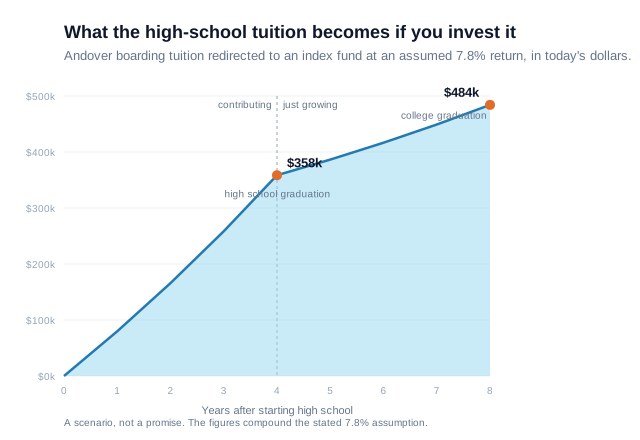
Path B is the alternative I rarely hear discussed in the prep-school orbit. The child attends a strong public high school. The family takes the equivalent of the Andover tuition, $79,800 a year for four years, and invests it in a broad-market index fund.
Assume a 7.8 percent annual return, a touch above the roughly 7 percent a year stocks have returned after inflation over the long run, and well below the roughly 10 percent before inflation.[6] I keep both the contributions and the ending balances in today’s dollars to stay consistent. That assumed rate is what drives the result, so treat the figures below as one scenario, not a promise.
By the time the child finishes high school, the account holds roughly $358,000. The family stops contributing and lets it grow during the four college years. By college graduation, the account holds roughly $484,000. That is a balance sitting in an account, not a lifetime earnings figure.
That is just the high school side of the ledger.
Now layer the college side, where my model is blunt. At full price the median four-year degree already lands about $82,000 behind simply finishing high school and going to work, because the cost outruns the earnings bump. Even at the typical price families pay after aid, it still lands about $17,500 behind.
An elite degree like Harvard’s clears that bar, since its graduates earn well above the median. But its earnings edge over a strong public university is small once you account for who gets admitted in the first place, the finding Dale and Krueger reported and the one I work through in What the Prestige Study Left Out.[7] So a family paying full Harvard prices over a strong public is buying a thin earnings premium at a steep cost premium.
On the college side, as on the high school side, the cheaper path tends to come out ahead. A parent named Tom Leung ran a version of this comparison in public. He weighed a $400,000 Cornell offer against UC Davis, modeled the cheaper path as a public honors flagship, and the cheaper public degree came out well ahead.
Combine the two windows. From the high school decision alone, the Path B family arrives at college graduation with roughly $484,000 in the account, before counting whatever the cheaper college path saves on top.
Every dollar of the spending gap between Path A and Path B went to school bills. For most students, the college half bought little measurable earnings edge.
The Counterargument and Its Limits
The Andover parent’s reply writes itself. “But Andover gets my child into Harvard.”
The Crimson data shows the channel is real. It cannot show how much of it Andover causes and how much comes from the students Andover admits, the same selection question Dale and Krueger raised about more selective colleges. Dan Lee, a private college counselor the Crimson quotes, calls it “correlation, not causation.”
The honest question is what the lift costs in dollars.
Run the back-of-envelope math. Assume Andover raises the probability of admission to a top-10 college by 20 percentage points over a strong public-school path. Twenty points is generous. But the actual lift is debated, varies by student, and applies less cleanly to a single school like Harvard than to a basket of selective schools.
At 20 points of lift, the family pays $319,000 in tuition for each child. That works out to about $16,000 for every point of better admission odds. If the real lift is smaller, the price per point is higher still.
The cost is large and certain. The benefit is neither. A full-price seat at Harvard earns only a little more than a strong public would. And even that small edge is not guaranteed. The family pays a fortune for it, up front and for sure. The payoff stays thin even when it lands.
None of this means the elite path never pays. For some students it clearly does. Sometimes the network really does open doors. Sometimes the child will thrive there and nowhere else. Sometimes aid cuts the price way down. And for some students, the ones Dale and Krueger flagged, including students whose parents had less schooling, the prestige premium stays large. The payoff is real for them.
The trouble, in my experience, is that the path gets pitched as if it pays for everyone. It does not. And the families who pay these tuitions in full tend to be the well-off, well-connected ones. For them the financial edge is thinnest of all. The point is not that the bet is always bad. It is that few families I meet check whether it is good for their own child. The pipeline gets treated as a sure thing instead of a decision.
Brand Versus Investment
There is a clean distinction between two reasons families pay these tuitions.
Some families view the Andover-to-Harvard sequence as buying club membership. The prestige is real, the network is real, the social identity is real. But none of these are financial returns. They are status purchases, and a family that values them clearly should buy them. The math is irrelevant to the decision.
Other families would describe themselves as investors. They hire wealth managers. They review portfolios. They run NPV on real estate decisions. The same families, on the 8-year education sequence, often skip the analysis they would never skip on an investment of this size.
The college decision is the second unexamined bet. The high school decision is the first, and by college graduation the larger one. Four years of Andover cost less than four years of Harvard, but that money had four more years to grow somewhere else. Wealthy parents thinking carefully in the senior year of high school have already placed the larger bet four years earlier.
The Window That Mattered
The math does not change. The window does.
A wealthy family agonizing over the college choice in senior year is studying only the second four years. The larger bet came four years earlier, at the high school door. And it usually got far less scrutiny. By the time the senior-year decision lands on the kitchen table, the larger bet has already been made and paid for.
In my experience, that is the analysis families skip. My book, We Need to Talk About Higher Education, is built around its college half. If you want to run the college side of it for any school and major, the calculator is at collegeroi.org, and I walk through what the prestige premium looks like once you count its price in What the Prestige Study Left Out.
Reference Sources
- Munger, Charles T. Poor Charlie’s Almanack: The Wit and Wisdom of Charles T. Munger. Expanded third edition, Donning Company Publishers, 2008. The quoted line is from Munger’s 2005 revision of his talk “The Psychology of Human Misjudgment,” written for the Almanack and printed in this 2008 expanded edition.
- Goncalves, Elyse C., Matan H. Josephy, and Grayson M. Martin. “Most Schools Dream of Sending Students to Harvard. These 21 Expect To.” The Harvard Crimson, 15 Nov. 2024. Accessed June 15, 2026. Crimson analysis of the past 15 freshman classes at Harvard, sourced from the school’s annual Freshman Register, identifying 21 high schools that accounted for roughly one in eleven Harvard students across those years.
- National Center for Education Statistics. “Common Core of Data and Private School Universe Survey,” as reported in Digest of Education Statistics 2023, Table 216.10 and Table 205.40. U.S. Department of Education. The Common Core of Data reports about 23,500 public secondary and high schools, and the Private School Universe Survey reports roughly 3,600 private secondary schools. Counting all private schools that offer high school grades, including combined K-12 schools, pushes the private total higher, putting the country on the order of 30,000 high schools.
- Phillips Academy. “Tuition and Fees, 2026-2027.” Comptroller’s letter to new students, Phillips Academy, March 2026. Boarding tuition for the 2026-2027 academic year is $79,800. Day tuition is $63,840.
- U.S. Department of Education. “College Scorecard.” U.S. Department of Education. Accessed June 15, 2026. Harvard’s full cost of attendance is about $85,540 a year in the author’s college model, drawn from College Scorecard data. Four years at today’s price comes to about $342,000. With the model’s 5.6 percent yearly cost increases, the four-year figure is about $372,000.
- Shiller, Robert J. Online data on U.S. stock prices, dividends and earnings since 1871, which place the long-run real return near 7 percent. Damodaran, Aswath. “Historical Returns on Stocks, Bonds and Bills: 1928-2024.” NYU Stern, January 2026, which places the S&P 500’s nominal return since 1928 near 10 percent. Multiple defensible assumptions exist for the 7.8 percent rate. At 7 percent, the account would hold about $464,000 at college graduation instead of about $484,000.
- Dale, Stacy, and Alan Krueger. “Estimating the Return to College Selectivity over the Career Using Administrative Earnings Data.” NBER Working Paper 17159, National Bureau of Economic Research, 2011. Accessed June 15, 2026. Dale and Krueger find the earnings premium of a more selective college is small once admission selection is accounted for, with exceptions for some groups of students. The median-degree figures are from the author’s own college model, not from Dale and Krueger: about $82,000 behind a high school path at full price, and about $17,500 behind at the typical net price. The full college math is in What the Prestige Study Left Out and the book.