The number that closes the door
There is one assumption underneath almost everything written about college in the last twenty years, and it is so large that it almost never gets checked. It goes like this. A college graduate earns far more over a lifetime than someone who stopped at high school. The number everyone quotes is $1.2 million. A gap that big settles the matter. If the payoff is that large, then doubt about it has to come from people who cannot do the arithmetic, and there is no reason to take their doubt seriously.
I want to take the doubt seriously. Not because the premium is fake. Because the way we handled the doubt is how we lost a generation of families.
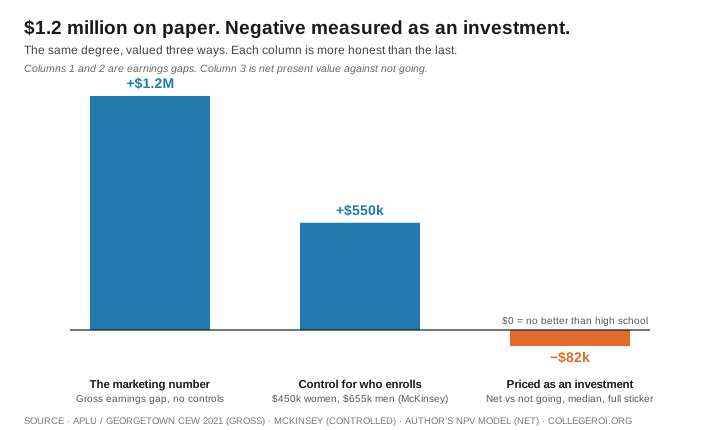
Start with the number, because the number is the whole engine. The $1.2 million is a real figure, published by serious people. The Association of Public and Land-grant Universities, the trade group for public colleges, puts the lifetime earnings gap at exactly that. Georgetown’s Center on Education and the Workforce lands in the same place, a bachelor’s degree worth $2.8 million over a career against $1.6 million for a high school diploma.[1]
But look at what kind of number that is. It is gross. It lines up everyone who finished a degree against everyone who stopped at high school, makes no adjustment for who was in each group to begin with, and adds up the dollars across forty years without shrinking a single one to what it is worth today.
Make only the first correction and it moves a lot. McKinsey, in a recent report on the future of American higher education, controls for the background of the people who actually enroll and reports a premium of $450,000 for women and $655,000 for men.[2] Roughly half the marketing number, gone, from a single adjustment. And that is before you discount the dollars to present value, and before you subtract the years of earnings the student gave up to sit in the seat. Even so, McKinsey calls the benefits clear. Once you accept clear, you stop looking. Clear is a door closing. Everything after it is logistics.
The doubt was the data
Now the part that got waved away. The same reports that quote the premium also quote the doubt, sitting right there in the next paragraph. McKinsey notes that 65 percent of students had come to agree that higher education is no longer worth the cost, up from 49 percent in under a year.[3] BCG cites Pew: only 47 percent of Americans now think a degree is worth it without loans, and just 22 percent think so once loans are involved.[4] Those numbers get treated as a mood. A perception problem. Something to fix with a better message.
But a premium is a median, and every median has a bottom half, and the bottom half is made of people. The non-completer carrying debt with no degree to show for it. The graduate earning less than the neighbor who went straight to work. The family that emptied the college fund and got back less than it put in. When those people say it was not worth it, they are not confused about the national average. They are reporting their own result. Calling that ignorance is not an argument. It is a way of deleting them from the dataset.
Here is the asymmetry that should bother anyone who cares about being right. Not every skeptic is a casualty. Some graduated, did fine, and are just anxious about the bill. Fair enough. The trouble is that you cannot tell which is which from a survey, and these reports resolve that uncertainty in the same direction every single time. Every doubter is misinformed. None of them are evidence. A careful person would say that some of that 65 percent are the wounded and some are the worried, and that the entire question worth asking is how many and which. The reports never ask. The assumption has already answered it.
Two firms, the evidence in their hands
You could forgive this in a hurried blog post. It is harder to excuse at the very top, among the people whose whole job is to find the root cause and who are paid handsomely to find it. So look at two of the most respected advisory firms in the world, and watch them walk past the question with the evidence in their own hands.
Take McKinsey first. Their report is built to make the case for graduating ten million more Americans over the next twenty years. Most of it is about access and completion, which are real problems. Then, inside their own recommendations, comes the number. Guide students, they say, toward the 64 percent of programs that deliver a positive return within ten years. Read that again. By their own count, 36 percent do not. More than a third of the product fails to clear a positive return within ten years, and that fact never sounds an alarm. It shows up as a routing tip printed underneath a growth target. The one number that should have stopped the report cold and asked whether more is even the right goal gets folded neatly into the plan to produce more. The frame does not bend. The customer’s doubt becomes a question of how to reach additional customers.
BCG does the same thing in a different register. The collapse in confidence, the 47 percent and the 22 percent, appears under a heading called the enrollment cliff, sitting next to falling birthrates and the aftermath of the pandemic. Think about what that placement does. The customer’s judgment that the product may not be worth it gets logged as a demand headwind, the same category of problem as a smaller graduating high school class. Weather, not evidence.
Everything that follows treats the trouble as external. Cut costs, find new revenue, optimize pricing, tighten retention, reinvent the business model. The product itself does appear. The report calls for high-ROI curricula aligned with employer needs, and it returns to career alignment and program-level return in several places. But the instruction each time is to prove the value and package it better. It never becomes check whether it pays and stop selling the parts that do not. And the pain the entire report is built around gets measured in the university’s own budget, a hit of $125 to $250 million a year for one illustrative school.[4] The patient is the institution’s income statement. The student appears as enrollment, as yield, as retention. As revenue.
I want to be fair about what these firms do and do not say. It is not true that they ignore the product completely. Both talk about high-return programs and career-aligned outcomes. The precise problem is narrower and worse than ignoring it. They admit the product varies, and they never once let that variation touch the conclusion. Product quality is allowed to be a routing variable, steer the kids toward the good programs, and a positioning variable, communicate the value better. It is never allowed to be a verdict. Neither firm asks the obvious next question. If a third of it loses, is more of it the right goal at all? They concede the range and then quarantine it from every recommendation that comes after.
Why the smartest people stop early
Why would some of the smartest analysts alive stop at exactly the spot where the real question begins? I do not think the answer is that they are foolish. There are four real reasons, and not one of them requires anyone to be dim.
The first is the client. Neither firm was hired by the seventeen-year-old. McKinsey works for the sector and the country. BCG works for the institution. Their root cause is correct for the client they actually have, because the university’s problem really is enrollment and cost and funding. Whether the degree is a good buy for the person purchasing it is simply not the question written on the contract. The blind spot is drawn by whose problem is being solved.
The second is the average itself. If you take the lifetime premium as a settled fact handed to you by the studies, then every bad outcome becomes a distribution problem or an execution problem, never a product problem, by construction. The median does the work of hiding the range. And the studies really do measure the median, and the median really is large. The error is quiet, and it is inherited. The analysts were raised on the same slogan as the families, hired through the same credentials, and handed the premise by studies wearing serious names. It is treating a number about the crowd as if it described the individual standing in front of you.
The third is selection, and it is the one economists have been pointing at for years. None of these premium figures cleanly separates what the school added from who the school admitted. Controlling for family background is not the same as controlling for the drive and preparation that earned the admission letter in the first place. Some real part of the premium is the return to the person, not the diploma. You only get to skip that question if you have already decided the product is good.
The fourth is what a report like this is built to produce. A consulting deliverable converts findings into actions a client can take. A finding that a third of the product does not clear a positive return is not an action. It is a verdict, and there is nothing in it for an institution to do on Monday morning. So it gets compressed into the only shape the format accepts. At McKinsey it becomes a routing tip inside a growth plan. At BCG it becomes an instruction to prove the value and package it better. Cost reduction, portfolio rationalization, a new business model, these are real prescriptions and often painful ones, and every one of them still takes the product as given. The finding survives the report. The alarm does not.
The blame always lands somewhere else
Put those four together and a pattern runs through the whole conversation, not just these two reports. Once you decide the product is good by assumption, every failure has to land somewhere else, and there is always a somewhere else on offer. Blame the student, who chose the wrong major or failed to finish or was never ready. Blame the politics, the funding cuts, the culture war over campus. Blame the market, the birthrates, the cliff, the arrival of AI. Blame the price, the loans, the aid formula, Congress. The diagnoses in both reports land in these four buckets. The seller is the single place the arrow never points. That is not an oversight. It is the assumption defending itself. If the product is good by definition, the fault must be external by definition, and the entire causal map gets drawn to keep one box clean.
The cruelty lives in the split. The credit gets shared and the failure gets pinned. The $1.2 million belongs to college, to the institution, to the national story about mobility. The loss belongs to the kid who should have picked a better major and worked a little harder. The average keeps the credit and the individual absorbs the blame. And the family that split falls on hardest is the one that could least afford the bet to begin with.
A household with money can lose a college wager and shrug it off. A household without it cannot, and when the wager goes bad the same system that sold it hands them the fault along with the loan balance. This is why I keep insisting the money question is the fairness question. Telling a low-income family that the premium is $1.2 million and the doubt is ignorance is the comfortable telling the exposed to relax about a risk the comfortable will never personally run.
What happens when you finally ask
So what happens when you finally ask the question all of this is built to avoid?
I asked it. I priced the degree the way you would price any large purchase, against the next best thing the same buyer could have done instead, after taxes, in today’s dollars, at real institutions with real prices and real earnings.
The picture is not the one the premium promises. At full price, the graduate of the median four-year institution ends up behind the person who skipped college and went to work, about $402,000 in lifetime value against $484,000.[5] Behind. Not at some fringe school with a famous scandal. At the middle one, the fiftieth out of a hundred. And when I set the price to zero, when I made college completely free, close to a third of four-year institutions still leave their median graduate worse off than the high school baseline.[5] That last number is the one that ends the argument about price. If a third of the product loses money even when it costs nothing, then price was never the whole story. The product is the story, for a large share of the people buying it.
None of that appears if you begin, as both firms do, from the premise that the product is sound and the only work left is access, cost, and a sharper message.
Now trace where that premise lands. A report like this does not stay in a boardroom. It becomes the conventional wisdom that a guidance counselor repeats, that a policymaker cites, that a well-meaning uncle passes across the Thanksgiving table. By the time it reaches a family, the range has been sanded off and only the headline survives. College pays. The premium is $1.2 million.
The doubt is for people who did not read the studies. So the family never runs its own numbers, because the smartest people in the country have signaled that the numbers are already run and the answer is settled. The foreclosure gets inherited. A seventeen-year-old and two exhausted parents end up carrying a decision the analysts upstream declined to actually make. And they carry it without the one piece of information that would have let them make it well, whether this school, at this price, for this kid, is a good bet or a bad one.
The doubt that everyone spent twenty years explaining away was not noise to be managed. It was the signal. It was the sound of the people for whom the investment did not work, trying to say so, and being told they had misread their own lives. The families who tried and could not make the numbers add up were not the system’s failures. They were its finding. We simply decided, in advance and at the highest levels, not to read it.
That decision is how college quietly turned into something you are supposed to need instead of something you get to choose. Necessity is what is left over after the real question goes unasked. And it went unasked all the way to the top, because the number looked too big to argue with and the doubt looked too easy to dismiss. Both of those were mistakes. The number was an average hiding a range, and the doubt was the range, finally speaking up.
Companion Pieces
Reference Sources
- Association of Public and Land-grant Universities. “How does a college degree improve graduates’ employment and earnings potential?” Public University Values, APLU. Accessed July 30, 2026. Bachelor’s-degree holders earn a median of 86 percent more than high school graduates, a lifetime difference of about $1.2 million. Georgetown University Center on Education and the Workforce. “The College Payoff: More Education Doesn’t Always Mean More Earnings.” Center on Education and the Workforce, Georgetown University, 2021. Accessed July 30, 2026. Median lifetime earnings of $2.8 million for bachelor’s-degree holders against $1.6 million for high school graduates, a gap of $1.2 million, 75 percent more. Both figures are gross: they compare degree-holders with non-degree-holders without adjusting for who enrolls, and they sum earnings across a career without discounting to present value.
- McKinsey and Company. “Ten million more graduates in 20 years.” McKinsey and Company, April 2023. Accessed July 30, 2026. Controlling for sociodemographic variables, the report puts the median lifetime earnings premium at $450,000 for women and $655,000 for men over a high school diploma, and states that the benefits of a postsecondary degree are clear. The same report recommends steering students toward the 64 percent of postsecondary programs that deliver a positive return within ten years, which means 36 percent do not, and frames its central goal as graduating ten million more Americans over twenty years. The demographic controls remove roughly half of the gross gap. They do not remove selection on the ability and preparation that earn admission.
- McKinsey and Company, the same report (note 2), citing a student survey: 65 percent of students agreed that higher education is no longer worth the cost, up from 57 percent in December 2020 and 49 percent in August 2020.
- Boston Consulting Group. “A Make-or-Break Moment for Colleges and Universities.” Boston Consulting Group, July 2025. Accessed July 30, 2026. Citing a 2024 Pew Research Center report, BCG notes that only 47 percent of Americans consider a college degree worthwhile without loans, and 22 percent with loans, and places this decline in confidence under an enrollment cliff, alongside a 15 percent drop in undergraduate enrollment from 2010 to 2021 (National Center for Education Statistics). BCG estimates the combined economic and federal-policy pressure on an illustrative university with a $1.5 billion operating budget at $125 million to $250 million a year.
- Shivamber, Leon. “College ROI Model and Calculator.” collegeroi.org, 2026, https://collegeroi.org. Accessed July 30, 2026. The author’s after-tax net present value model, built on U.S. Department of Education College Scorecard data, covering 1,679 bachelor’s-granting institutions: net present value versus the high school path, after costs, federal income and payroll taxes, forgone earnings, and a 7.8 percent discount rate. At full sticker price, the median institution’s graduate ends at about $402,000 in lifetime value against $484,000 for the high school path, roughly $82,000 behind. Even at zero cost, close to a third of four-year institutions, about 30 percent, still leave their median graduate behind the high school path. Run any school at https://collegeroi.org/roi.