There are about 42 million Americans carrying federal student loans, and together they owe roughly $1.7 trillion on the Education Department’s books.[1] At for-profit schools, 52 percent of the borrowers who started college in 2003-04 defaulted within 12 years.[2]
Every few months the country has the same fight about what to do, and the fight splits cleanly into two camps that cannot stand each other.
I have written before about how even the experts miss what sits in their own data, and what that blind spot costs, in The Damage When Smart People Miss Critical Insights. Here I want to take on what to do about it.
I want to take both sides of this argument seriously, because both of them are right about something real. Then I want to show you the part the fight leaves out, which turns out to be the part that decides whether this ever ends.
The honest case for forgiveness
Start with the strongest version of the case for canceling the debt, not the bumper-sticker version.
The government built this lending system to be careless, almost by design. Over several decades it guaranteed the loans, which stripped private lenders of most of their risk, and made student debt one of the hardest debts to clear in bankruptcy, erasable only if the borrower proves undue hardship.[3]
A lender with little risk has little reason to ask whether a loan makes sense, so the loans went out based on whether a student enrolled, not on whether they could ever repay.
I know of no other credit market this large that works this way. Your mortgage, your car loan, even your credit card all involve someone checking whether you can pay it back. Student loans did not.
The system then lent freely to people who predictably could not repay, for programs that predictably did not pay. The economist Constantine Yannelis of Chicago Booth put it plainly in 2019: for-profit colleges “account for about 10 percent of enrollment, about 20 to 25 percent of borrowing.” Official federal counts for 2014 through 2017 put them at about a third of all borrowers who defaulted. That is a clear sign of where the money flowed and how predictably it failed.[4]
Outside the for-profits, the borrower was often 17 or 18, told their whole life that college always pays, and handed no real data on how that specific school or major actually performs. The one party with the expertise to run the numbers, the government, was not required to use it, loan by loan. The one party with no expertise, the teenager, carried the personal risk.
And here is the part many opponents skip. The taxpayer is already absorbing these losses. Income-driven repayment plans already forgive unpaid balances after 20 to 30 years.[5] Many borrowers are already behind. The loss sits on the books whether or not we ever say the word forgiveness out loud. On this view, canceling some of this debt is less a gift than an honest accounting of a system the government built to fail.
That is a serious argument. Now the other side, just as seriously.
The honest case against forgiveness
The strongest objection to broad forgiveness is not that borrowers deserve a scolding. It is that broad forgiveness gives the least to the households that need it most.
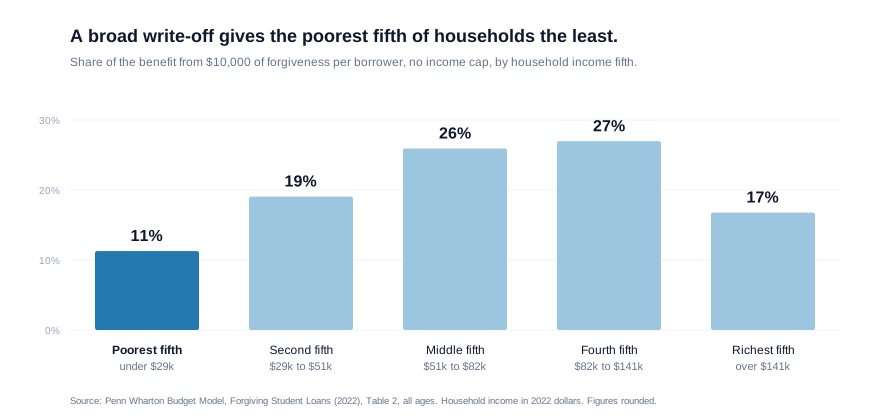
When the Penn Wharton Budget Model studied broad cancellation, it found that only about a tenth of the benefit reaches the poorest fifth of households, the least of any fifth. More than half goes to households earning between about $51,000 and $141,000. Capping eligibility at $125,000 of income barely changes the split.[6]
A 50-year-old who never went to college, and never earned what a degree pays, gets nothing, while people who on average out-earn her see their debts cleared. That is a hard way to help the people who need help most.
It is also unfair in a plainer way. Most American adults do not hold a bachelor’s degree, and many who borrowed scraped and sacrificed to pay their loans off. A one-time cancellation tells all of them they were the fools for keeping their promise.
Then there is the part that should worry anyone who cares about the next class of students. Forgiveness does nothing to the schools that caused the problem.
A college that collected full tuition while its former students defaulted pays nothing when that debt is forgiven. Bailing out its bad outcomes quietly signals that lending for low-value programs is safe, which invites more of it. And once everyone expects the next round of forgiveness, schools have even less reason to hold prices down. You can raise tuition freely if the loans behind it might be wiped away anyway.
And the cost is real, somewhere between $300 billion and nearly $1 trillion over ten years depending on the plan, money that has to come from somewhere or pile onto the national debt.[6]
These are not talking points. They are serious objections.
Both camps are fighting over the wrong thing
So we have two camps, and both are right. The debt was manufactured by a system the government built carelessly. And canceling it broadly would give the least to the poorest households, be unfair to people who never borrowed, and invite the whole thing to happen again.
The composition cuts the other way at the bottom. The borrowers most likely to default hold small balances, often with no degree behind them, while the largest balances sit with graduate degrees and the incomes to match.[7] Both camps are right about different borrowers, which is why the argument never ends.
Here is what gets lost in the shouting. Both camps are arguing about the same pile of existing debt, and the argument leaves out the machine that produced it.
One side wants to clear the pile. The other wants to protect the taxpayers who would be asked to pay for clearing it. But the machine that built the pile is still running. Forgive every dollar tomorrow, change nothing else, and a fresh pile starts forming the next semester, built the same way, out of the same unchecked loans.
There is a third argument, that forgiveness would stimulate the economy and lift a weight from millions. Whatever its merits, it is also an argument about the pile. It says nothing about the machine.
The debt is not the disease. It is the symptom. The disease is a lending system with no underwriting.
The defect, in plain sight
Picture an 18-year-old. Call him Daniel. He is the first in his family to go to college, and he and his parents sign for $74,000 in loans to attend a program whose graduates earn a median of about $41,000. Those figures are illustrative. The pattern behind them is not, as the numbers below show.
Nobody stops him. Nobody runs the math, because nobody is required to.
The lender, which is the federal government, does not check, when Daniel signs, whether the program pays back what it costs. It does not ask what Daniel will earn. It does not cap the loan at anything tied to his prospects. It approves the money because Daniel enrolled, with at most a look at his parents’ credit history.[8]
Congress took a step in 2025. Under that law, an undergraduate degree program whose graduates earn less than a typical high school graduate will lose access to federal loans, but only after it fails two years out of three, and the first cutoffs are still years away. Even then, the test never asks what the program costs or what Daniel borrowed.[5]
Now compare that to how the same government treats a mortgage. Since 2014, a lender must make a documented, good-faith determination that you can repay a mortgage before it writes one. Income verified, debts counted, ability to repay documented.[9] We decided after the 2008 crash that lending people money they cannot pay back for a house is dangerous. We have barely begun to apply that lesson to lending people money they cannot pay back for a degree.
That is the defect. The student-loan system funds the investment without ever asking whether the investment returns more than it costs.
This is structural, not bad luck
You might hope Daniel is a rare case. He is not.
Run the return on the 1,679 four-year colleges with enough data to score, and even at the price families actually pay after aid, about 58 percent leave their median graduate worse off than if they had skipped college and gone straight to work. At full sticker it is roughly 79 percent, so only about one in five clears the bar. About 30 percent fail to beat that path even if college were free.[10]
The schools that clear the bar are the point of the fix. The engineering degree at a low price, the nursing program whose graduates nearly all find work, the trade that pays from year one, those are the loans underwriting is built to approve. The job is to fund the program that pays back as surely as it stops the one that does not.
This is a system that reliably lends for programs that do not pay back what they cost, because it funds them without asking. After inflation, the average sticker price of college rose about 169 percent between 1980 and 2019, while the average earnings of young adults rose about 19 percent.[11] A lending system with no underwriting and nothing holding prices down did nothing to close that gap, year after year.
So forgive only if you fix the flow
This is where the two camps can finally be reconciled, and it starts by separating two different problems.
There is a stock problem, the pile of debt that already exists, much of it created by a system the government ran carelessly. And there is a flow problem, the machine still manufacturing new debt behind it. Forgiveness, at most, touches the stock. It does nothing for the flow.
If we do touch the stock, aim at the bottom of it. Every federal borrower who owes less than $10,000, about 14 million people, owes about $71 billion in all.[12] That is a fraction of what a broad write-off would cost, and it reaches the borrowers most likely to default.
So fix the flow first, or at least at the same time.
Underwrite the loans, the way a mortgage lender must, against what the program’s graduates are likely to earn. Tie a program’s eligibility for federal loans to whether its graduates earn back what they paid, compared with going straight to work. The 2025 test, which asks only whether they out-earn a high school graduate, is a start.
Put the real return of each school and major in front of students before they sign, not after. And give the institutions skin in the game, so a college that loads students with debt it knows they cannot repay shares in the loss.
Notice what that fix does to the fairness fight. The distribution objection is a powerful argument against forgiveness, because broad forgiveness gives the least to the poorest households. But it is no argument at all against fixing the system, because underwriting aims its help at the low-income, high-default borrowers that objection means to protect, and it does it without cutting a check to anyone who is already doing fine.
The forgiveness side’s best argument survives the same test. If the government built a careless machine, cleaning up the wreckage it created is fair, and fixing the machine means the cleanup will not have to be repeated. Reform does not retire either camp’s strongest point. It just moves both of them onto ground where they can finally agree.
There is one real objection to underwriting, and it deserves the honesty I gave the two camps. Tie loans to earnings and you risk cutting off access. A program that serves mostly low-income or first-generation students can post weak earnings because its graduates face a labor market that pays them less, not because the program failed them. Underwrite carelessly and you could lock out the very students a fair system should lift. That is the strongest case against the fix, and it is right about the danger.
But the danger can be managed, and the status quo already fails these students hardest. They are the ones most likely to default, and many are left with debt and no degree. Refusing to finance a program whose graduates reliably cannot repay is not denying opportunity. It is declining to sell a known lemon on credit the buyer cannot carry.
The fix is not a blanket cutoff. It is underwriting aimed at the programs the data condemns. Pair it with disclosure that lets a student see the odds, and with institutional skin in the game, so the school answers for a bad bet, not the teenager. Done that way, underwriting protects access. It steers students away from debt that closes doors and toward the paths that actually pay.
Forgiveness without reform is a bailout. It clears the books for the outcomes that cost the most and leaves the trap set for the next teenager. Forgiveness paired with reform is a correction. It cleans up a mess the government made and stops the government from making it again.
The reckoning is coming either way
The write-offs are coming. They are already coming, quietly, through repayment plans that cancel whatever is left after 20 years or more.[5] That part is not really up for debate.
The only real choice is whether we also turn off the machine that keeps requiring them. We can keep having the same furious argument every few months about whether to clear the pile, while the system behind us manufactures the next one. Or we can fix the thing the forgiveness fight keeps leaving out.
This is not about whether student borrowers are heroes or freeloaders. It is about a simpler question. The federal government is running a credit system that would look reckless in almost any other market of this size, one that lends enormous sums without asking, loan by loan, whether the money can ever come back. The fight over forgiveness is a fight about the wreckage. The machine is still on.
Reference Sources
- Federal Student Aid, U.S. Department of Education. “Federal Student Loan Portfolio.” Federal Student Aid Data Center, 2026. Accessed September 28, 2026. Portfolio summary for the third quarter of fiscal 2026: about 42.3 million recipients and $1.72 trillion in outstanding principal and interest.
- Scott-Clayton, Judith. “The Looming Student Loan Default Crisis Is Worse than We Thought.” Brookings Institution, 11 Jan. 2018. Accessed June 15, 2026. On for-profit default rates and the concentration of defaults.
- Iuliano, Jason. “Bridging the Student Loan Bankruptcy Gap.” American Bankruptcy Law Journal, vol. 99, no. 3, 2025. Accessed September 28, 2026. On the Education Amendments of 1976, whose bankruptcy limit “applied only to federally insured or guaranteed student loans and loans made by nonprofit institutions of higher education”. Also 20 U.S.C. § 1078(b)(1)(G), Legal Information Institute, Cornell Law School. Accessed September 29, 2026. The guaranteed-loan program insures 98 percent of a loan’s unpaid principal, 97 percent for loans first disbursed from July 2006 to June 2010.
- Gold, Howard R. “Who’s at Fault for Student-Loan Defaults?” Chicago Booth Review, 13 May 2019. Accessed September 28, 2026. Quoting Constantine Yannelis on the for-profit shares of enrollment and borrowing. For the share of defaulters, Federal Student Aid, U.S. Department of Education. “FY 2016 Official National Cohort Default Rates.” FSA Partner Connect, Sept. 2019. Accessed October 5, 2026. And “FY 2017 Official National Cohort Default Rates with Prior Year Comparison and Total Dollars as of the Date of Default and Repayment.” FSA Partner Connect, Sept. 2020. Accessed October 5, 2026. Proprietary share of borrowers who defaulted within three years: 194,027 ÷ 580,671 = 33.4 percent (2014), 182,686 ÷ 531,653 = 34.4 percent (2015), 149,892 ÷ 458,687 = 32.7 percent (2016), 125,657 ÷ 417,429 = 30.1 percent (2017).
- Congressional Research Service. “Amendments to the Higher Education Act Made by P.L. 119-21, the FY2025 Budget Reconciliation Law.” Report R48727, January 8, 2026. Accessed September 25, 2026. On the earnings test for Direct Loan eligibility, the Repayment Assistance Plan’s cancellation after 30 years, and the end of new FFEL loans in 2010. Also National Association of College and University Business Officers. “ED Finalizes Earnings Accountability Rule.” NACUBO, 6 July 2026. Accessed September 28, 2026. On the final rule of June 30, 2026, and consequences “several years away”.
- Penn Wharton Budget Model. “Forgiving Student Loans: Budgetary Costs and Distributional Impact.” Penn Wharton Budget Model, University of Pennsylvania, 23 Aug. 2022. Accessed June 15, 2026. On the cost of broad cancellation and the distribution of its benefit by household income (Table 2, all ages), across six versions with and without income caps. The chart shows $10,000 of forgiveness with no income cap. The income fifths split at about $28,800, $50,800, $82,400 and $141,100 of household income.
- Brown, Meta, Andrew F. Haughwout, Donghoon Lee, Joelle Scally, and Wilbert van der Klaauw. “Looking at Student Loan Defaults through a Larger Window.” Liberty Street Economics, Federal Reserve Bank of New York, 19 Feb. 2015. Accessed November 11, 2026. Among borrowers who entered repayment in 2009, about 34 percent of those who owed less than $5,000 had defaulted by the end of 2014, against 18 percent of those who owed more than $100,000 (credit-bureau data, private loans included). Also Miller, Ben. “Who Are Student Loan Defaulters?” Center for American Progress, 14 Dec. 2017. Accessed October 5, 2026. Of students who entered college in 2003-04 and borrowed federal loans, 49 percent of those who defaulted had dropped out. And Baum, Sandy, and Adam Looney. “Who Owes the Most in Student Loans: New Data from the Fed.” Brookings Institution, 9 Oct. 2020. Accessed November 11, 2026. In 2019, households with graduate degrees owed 56 percent of education debt. Households with professional and doctoral degrees held 20 percent, with median earnings of $106,000 against $47,000 overall.
- Federal Student Aid, U.S. Department of Education. “PLUS Loans: What to Do if You’re Denied Based on Adverse Credit History.” Federal Student Aid. Accessed September 28, 2026. On the adverse-credit-history check, which does not test income or ability to repay.
- Consumer Financial Protection Bureau. “Ability to Repay and Qualified Mortgage Standards Under the Truth in Lending Act (Regulation Z).” Consumer Financial Protection Bureau, in effect since 2014. Accessed June 15, 2026. The rule text, 12 CFR 1026.43 (accessed September 28, 2026), requires the lender to consider the borrower’s income and current debt obligations and to verify the income it relies on. On the rule’s origin in the mortgage crisis, see the Bureau’s final rule, “Ability-to-Repay and Qualified Mortgage Standards Under the Truth in Lending Act (Regulation Z).” Federal Register, 78 FR 6408, 30 Jan. 2013. Accessed September 28, 2026.
- College return figures are computed in the author’s own model across 1,679 four-year colleges. They count schools, not students, and measure the return to graduating: about 58 percent leave their median graduate worse off than a high school graduate at net price, about 79 percent at full cost of attendance (about 21 percent clear the bar), and about 30 percent even at zero cost. They are not graduation or completion rates. You can run any school and major at collegeroi.org.
- Georgetown University Center on Education and the Workforce. “If Not Now, When? The Urgent Need for an All-One-System Approach to Youth Policy.” Center on Education and the Workforce, Georgetown University, 2021. Accessed June 15, 2026. On the 169 percent rise in the average price of tuition, fees, room and board against a 19 percent rise in the average earnings of young adults aged 22 to 27 (Figure 3, read from the chart), from 1980 to 2019. Both series are inflation-adjusted: costs in constant 2018–19 dollars, earnings in constant 2019 dollars. The figures are in the full report PDF (accessed September 28, 2026).
- Federal Student Aid, U.S. Department of Education. “Federal Student Loan Portfolio by Borrower Debt Size.” Federal Student Aid Data Center. Accessed November 11, 2026. For the second quarter of fiscal 2026 (through March 31, 2026), borrowers who owed less than $5,000 held $18.9 billion (6.9 million borrowers) and those who owed $5,000 to $10,000 held $52.5 billion (7.2 million), together about $71.4 billion and 14.1 million borrowers. The table covers Direct, FFEL and Perkins loans in open status. For the cost of a broad write-off, $300 billion to nearly $1 trillion, see note 6.
Part of a series, The Debt Machine, on one idea: the way America finances college is a lending system with no underwriting, and it quietly drains household wealth before anyone connects the cause to the effect.
- The Viral Homebuyer Chart Is Wrong: the real drain on down payments is worse than the chart.
- Two Kinds of Debt: why the law makes mortgage lenders underwrite strictly and asks almost nothing of student loans.
- The Student Debt Fight Is About the Wrong Thing: both sides of the forgiveness debate miss the machine that keeps manufacturing the debt.
These essays extend the argument in my book on college return on investment. You can run the return on any school and major using the Explore ROI menu right here at collegeroi.org.